It was a beautiful and bright day on Saturday, April 12—perfect for a wedding. The sun gazed upon us as we gathered for a backyard celebration of my cousin and her beau. The sun was in rare form that day. Warm, but not hot. Bright, but not blinding. Just right. My family commented on the weather, complimenting the spectacular day.
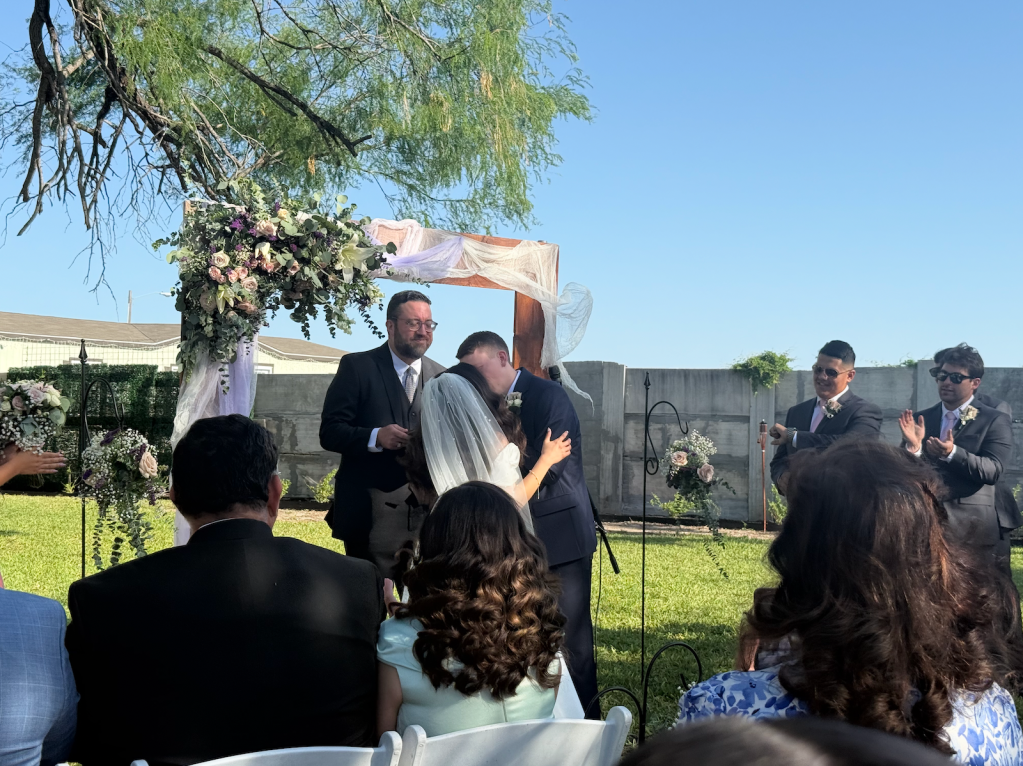
My eyes welled with joy as the sun—a star—bathed my cousin’s walk down the aisle in golden light. As time ticked forward, it was as if the sun refused the inevitable, gripping tight onto every passing minute, unwilling to release control. It did not want to go down without a fight. Almost as if it knew better than God.
We’ve all been the sun, haven’t we?
That afternoon, the pastor serenaded us with what I consider to be the Gospel reading for Christian marriages—1 Corinthians 13.
Love is patient, love is kind.
It is not jealous, is not pompous,
it is not inflated, it is not rude,
it does not seek its own interests,
it is not quick-tempered, it does not brood over injury,
it does not rejoice over wrongdoing but rejoices with the truth.
You know, for 40 years, I grew up thinking Saint Paul was exclusively addressing marriage, because that’s when the reading was often shared in my life. Marriage is hard. Love helps.
But last year, I learned that the deep and meaningful love Paul was describing should actually extend—far beyond the comfort of our partner—out into our community.
In an exploration of my own relationship with God, I attended service at Friendswood Friends Church last year. And it was there, in that Christian church, that Paul’s letter connected me to my Catholic faith and the secular world in a whole new way.
Paul had established the Christian church in line with Jesus’ teachings. Some people in Corinth were all in. But like any seriously major change, human beings struggled in the shift.
Integrity is hard.
Change is hard.
Mistakes happen.
Shame, guilt and judgment are all part of the human condition.
So are grudges.
So is ego.
Factions had formed among the Corinthians.
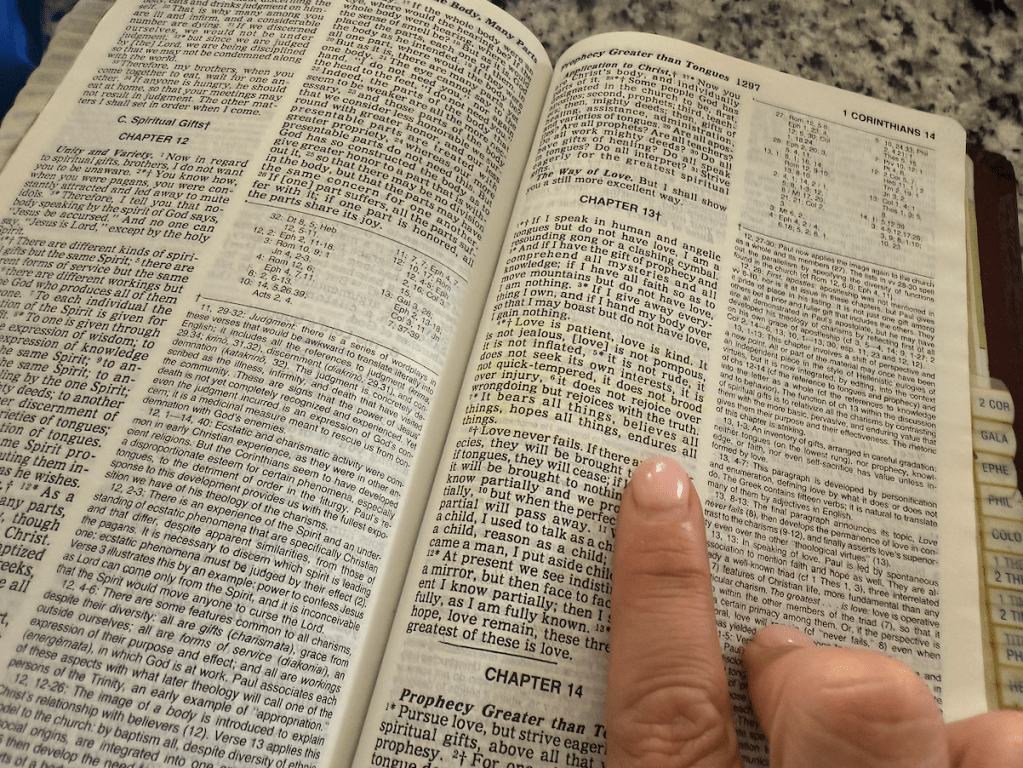
Bible study taught me that certain members in Corinth were identifying themselves exclusively with specific Christian leaders or choosing to interpret Christian teachings as a superior wisdom for a select few while using Christ’s teachings to judge and belittle others.
People were living in incest, others were engaging in prostitution or participating in temple sacrifices. People denied kindness to the poor or drank too much during fellowship.
Conflict in Corinth fed disunity, immorality and false teachings.
Essentially, some people thought they were the sun.
Because the internet, cars and cellphones didn’t exist then, there were many letters apparently sent back-and-forth, between the Corinthians and Paul. They wrote to him to get help getting past their differences, their grudges and their egos.
The study of the letter is fascinating, because we learn a lot about Paul. He basically got this Christian church in Corinth off the ground. He could have made all these rules, regulations and judgments and shamed those people into making better choices. I mean, think about what life was like back then. We didn’t have the education, freedoms and power of choice like we do now. In my mind, Paul could have said whatever he wanted and that would have been that.
Instead, he double-downed in Jesus’ teachings and wrote from a place of hope. I believe, from a place of forgiveness—not absolving people of their behavior, but encouraging them to try again and do better. For me, it’s all about context.
Scholars think Paul wrote a series of letters. The first one, I think most of us would agree, knocked it out of the park.
A reading from the first letter from Saint Paul to the Corinthians:
Brothers and sisters,
If I speak in human and angelic tongues but do not have love, I am a resounding gong or a clashing cymbal.
And if I have the gift of prophecy and comprehend all mysteries and all knowledge; if I have all faith so as to move mountains but do not have love, I am nothing.
If I give away everything I own, and if I hand my body over so that I may boast but do not have love, I gain nothing.
Love is patient, love is kind.
It is not jealous, is not pompous,
it is not inflated, it is not rude,
it does not seek its own interests,
it is not quick-tempered, it does not brood over injury,
it does not rejoice over wrongdoing but rejoices with the truth.
It bears all things, believes all things, hopes all things, endures all things.
Love never fails. If there are prophecies, they will be brought to nothing; if tongues, they will cease; if knowledge, it will be brought to nothing.
For we know partially and we prophesy partially, but when the perfect comes, the partial will pass away.
When I was a child, I used to talk as a child, think as a child, reason as a child; when I became a man, I put aside childish things.
At present we see indistinctly, as in a mirror, but then face to face. At present I know partially; then I shall know fully, as I am fully known.
So faith, hope, love remain, these three; but the greatest of these is love.
And you know what love is? It’s forgiveness.
Although the Scripture reading works as a wonderful send off for newly weds, it works well for all of us.
As my cousin stood hand-in-hand with her soon-to-be-husband, we all listened as the pastor asked us to consider more. Ready?
Show me a family that is genuinely close, and I’ll show you people who know how to forgive.
Whoa!
Ain’t that the truth?
Genuine connection requires vulnerability, acceptance, belonging and forgiveness. A whole lot of forgiveness.
Sometimes, forgiveness is so hard—like really, really hard.
We can’t force people to forgive us. We cannot beg our way into forgiveness. Faith alone or dedication to Sunday church services aren’t enough. Forgiveness is faith, in action.
I suppose that’s why when reflecting on my life, I don’t fully understand how people have forgiven me. The path to forgiveness isn’t one that we can necessarily see. But believe me, it’s possible.
I’ve said some pretty nasty things in my lifetime. I’ve slammed doors in my parents’ faces and spewed phrases I wish I could take back. I’ve taken my sisters for granted. I’ve ghosted friends. I’ve walked into newsrooms like a callous warlord, pushing colleagues over the edge or to the verge of tears. I’ve definitely not been a nice person.
Hatred is one of those things that we as human beings, unfortunately, pay forward.
Those same vicious attacks have also been launched against me.
I’ve allowed myself to stay the course in abusive relationships. I’ve selfishly chosen to spend money on material things instead of helping my neighbors. My internal dialogue has been depressing and mean, and there are times when I’ve definitely talked myself out of dreaming or wanting more for my life. There are times when I’ve looked the other way instead of mustering up the courage to speak out.
Externally, I once answered a newsroom phone call from a viewer in Odessa, Texas.
“Tell that girl Melissa to go back to Mexico where she came from,” he spewed as I listened in shock. “And tell her to take her family with her.”
A couple of years later, a DJ for a radio station played a clip of me he had recorded as I ended one of my reports in Virginia.
“Reporting from Richmond, I’m Melissa Correa,” I said with roll of the double r.
“We get it,” he blurted on air. “You’re Hispanic,” as he continued to harp about how I should be ashamed to shove my heritage down people’s throats. Some radio show callers agreed.
Viewers found the courage to approach me in public to ask, “How do you speak such great American, being from the border?” or “I’m really glad you’re reporting, even though your body looks the way it does.”
In those fleeting moments of human connection, people sometimes say the weirdest things.
People have lied to me. Betrayed my trust. Thrown me under the bus. Stolen from me. Taken advantage of my kindness. Made me the butt of their jokes.
Eventually, I’ve doled out forgiveness for all of it. Resentment transformed into boundaries or closure or a graceful, vaya con Dios!
If I were to pocket every grudge and judge every offense, I’d miss out on genuine connection. I’d miss out on a chance to grow. And we’d all miss out on a second chance.
Merriam-Webster reminds us that “forgive” is a verb—to cease to feel resentment against.
Even more fascinating, according to the Mayo Clinic, forgiveness can positively impact your physical and mental health. Letting go of grudges and bitterness can make way for improved health and peace of mind. Forgiveness can lead to:
- Healthier relationships
- Improved mental health
- Less anxiety, stress and hostility
- Fewer symptoms of depression
- Lower blood pressure
- A stronger immune system
- Improved heart health
- Improved self-esteem
A podcast produced by the American Psychological Association dives into the power of forgiveness, which some may see as an act with deeply religious ties.
Our research has looked at people from all walks of life, Muslim, Buddhist, Christian, Jewish, humanistic, atheistic,” said Robert Enright, PhD, is a professor of educational psychology at the University of Wisconsin-Madison, a licensed psychologist, and the cofounder of the International Forgiveness Institute. “Isn’t it true that an atheist wants to be fair or just in the world, treating people with fairness, obeying the traffic rules? Absolutely, of course. And so, there’s nothing in the rulebook of forgiveness that says you have to be a certain kind of believer to engage in it, just like the whole world engages in justice, regardless of culture.”
Doctors, therapists and faith leaders will tell you that forgiveness is much easier to do if you seek help.
Grace and mercy help our human brains get to that point—forgiving others, not because we want to, but because we need to for our own personal good.
Forgiveness doesn’t excuse the behavior. And there may some experiences that may take a lifetime to forgive, up until our very last breath on this earth. But, forgiveness is possible.
I’ve witnessed families of murder victims forgive killers. I’ve witnessed victims of hate crimes forgive their attackers. I’ve talked to children who’ve forgiven their classmates who’ve bullied them.
While forgiveness alone may not reconcile the situation, it sure can start the process.
Because if we don’t forgive, take family members for instance, there is an indescribable dose of regret that comes with losing any and all opportunity.
In July 2023, an estranged family member passed away suddenly. In the decade or so that I didn’t speak to him assumptions were made, emotional walls went up and my heart broke just a little more. And then he was gone—with neither of us actively forgiving the other. I don’t wish that missed opportunity on anyone.
I’m now working to forgive myself. And in a short aside to this blog, a few months ago, that family member appeared in my dreams and asked me for forgiveness, too. In my dream, I was a little girl sitting at my grandparents kitchen counter and he was his younger self. I remember feeling so good in my dream. When I woke up I wept and thanked God for that touchstone.
Because, although the cliché sings: practice makes perfect—in the case of forgiveness, I’m not sure it gets easier. Every situation, every hurt, every trauma is different. But I know this for sure, it definitely feels better when I forgive, and each moment of forgiveness generates more courage within us, especially when we forgive ourselves.
I like to think that the self-conscious, hurt and frightened girl who lashed out with the soul-slicing power of words has softened and matured with each dose of God’s grace and mercy.
I hope as you reflect on the chapter’s of your own life, you can take stock of your own growth, too.
Because much like the pastor’s message of forgiveness that Saturday afternoon, the sun did inevitably surrender—as it always does. It relinquished its chokehold on the day, slowly setting as its warm glow inched toward the horizon—creating space for one of those fairytale nights where delicate winds deliver waves of clarity and a sense of possibility.
Just like forgiveness, getting to that point may feel like a blaring, blistering fight—but once we surrender, we make way for peace. A quiet reset. And a whole new day that starts with three life-changing words, I forgive you.

 Consider More
Leave a comment